
May 21, 2009
In a recent interview with Paul Solman, behavioral economist Dan Ariely asserted that financial cheating might result when people deal in abstract vehicles rather than tangible cash. His experiments even show that “New York bankers are the only group that cheats more, much more, by about twice as much”. A possible root cause: the abstract nature of financial instruments with which bankers deal. Ariely then suggested that for a bank to succeed in the future might depend upon maintaining transparent relationships with its customers.
Leading to our financial crisis, the securitization of loans raised a similar abstraction layer between borrowers and lenders. In his experiments, Dan might consider studying the degree to which a borrower tends to obscure her genuine capacity to repay debt.
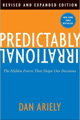
The title of his recently revised and expanded book has a certain degree of irony. Will we ever reach a point when a model can accurately predict irrationality? The ease with which computers calculate intricate formulas often deceives the unsuspecting with an unfounded sense of accuracy. Next time around, will more transparency and the stream of information that ensues enable clever minds to build more accurate algorithms for irrationality?
April 08, 2009
The Bach cantata Ihr werdet weinen und heulen BWV 103 composed in 1725 features a rarely heard instrument. In Soli Deo Gloria Cantatas Vol 24, John Elliot Gardiner notes that BWV 103 “opens with a glittering fantasia for a concertante violin doubling a sixth flute — a soprano recorder in D.”
I have thoroughly enjoyed this performance by the Monteverdi Choir and English Baroque Soloists since its release in 2005.

This week, I listened to Masaki Suzuki’s Bach Collegium Japan recording of BWV 103. As before, the soprano recorder appeared in the opening movement, played by Dan Laurin. From the SACD notes, “For the introductory chorus Bach chose a most unusual sound image: the normal orchestral strings are joined by two oboi d’amore and a flauto piccolo, in modern terminology a descant recorder in d″ (Bach gave this rarely used instrument a concertante solo part of the utmost virtuosity).”
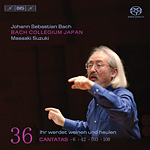
With the third movement, the alto aria, Suzuki took a different course. Rather than a concertante violin as we heard with the English Baroque Soloists, we hear a flauto piccolo “once more making its presence felt with a virtuosic obbligato line”. We have stumbled upon a different cantata.
A glance at the score uncovers the mystery. For that instrumental part Bach provided an option of “Violino concertante o Flauto traverso”.
The composer may have had various reasons to give the conductor this latitude. Ongoing reinterpretation has kept Bach’s work alive. Did Bach realize that by deliberately not over specifying his intentions in this cantata, he would enrich his legacy this many centuries later?
February 24, 2009
“. . . has no sense of freedom in it; and it is too reminiscent of those other things which are exact in an entirely different sense.
Usually, when we say something is exact, we mean that it fits some abstract image perfectly. If I cut a square of cardboard, and make it perfectly exact, it means that I have made the cardboard perfectly square: its sides are exactly equal: and its angles are exactly ninety degrees. I have matched an image perfectly.
The meaning of the word ‘exact’ which I use here is almost opposite. A thing which has the quality without a name never fits any image exactly. What is exact is its adaptation to the forces which are in it. But this exactness requires that it be loose and fluid in its form."